Dunkirk NY – I had a rehearsal last night for a benefit reading I am participating in for Shakespeare in Delaware Park. I always help out when I can with their fundraisers because I’ve been offered so many opportunities with the company all these years that I feel it’s the least I can do. I had to drive up in the dark since it gets dark by 5 PM now, and that actually took just a bit of adjustment. It’s the first time I’ve been out on my own for an extended period of time, and the most amount of driving I’ve done in over two weeks. I really don’t have much to do – just two small scenes – and we are doing all this on book. So it’s not all that taxing.
Nonetheless, I found that I had to get my leg elevated after a bit. It wasn’t that I was in pain or anything. It felt more like fatigue in the leg, like the leg was just getting tired. I also wanted to keep the leg moving as well, so in between scenes I walked around a bit. The rehearsal went longer than I expected, and when I got home I immediately slapped some ice on it. The biggest mistake I made, however, was stopping at Wendy’s and picking up two junior bacon cheeseburgers and small fries. I think that sat in my stomach all night and caused a bit of restlessness. The gig is next weekend, so I have until Sunday evening to rest before doing that again.
I think the fatigue factor is perhaps most annoying. I honestly don’t have a lot of pain, no more at this point than one would experience with, say, a sprain or slight twist. But I do at times feel the fatigue. Simple tasks like cleaning up after dinner or rolling the summer tires down to the basement are tiring. I presume my body is putting a lot of effort into repairing that knee, perhaps more effort than I can really sense. But like all recoveries, it gets boring to sit around all day and accomplish very little.
Yet that is another thing to consider – what is there to accomplish? And why should I be concerned about that? Perhaps I am over-concerned with this idea of getting things accomplished. The question has been on my mind since retiring, and at some point I need to settle this question. Not today. But at some point. -twl
Dunkirk NY – This morning I am enjoying the last bit of peace I am going to get for the next week. Starting tomorrow night, the house will be filled with 4 more people. One of them is 10 years old, and not my grandchild. Not that I mind, but it does mean my usual routine will be interrupted, and my house will be fuller and busier than normal.
Times like these make me realize how much I have become used to having the house be a refuge for peace and quiet, and how much I like it. When I retired, I gave myself three years to allow the stress of work to shed itself from my system. I figured after 43 years of working, it might take that long. And it has. I enjoy getting up a little later, and my usual morning routine is now quite relaxed. I am seldom ever ready for the day before 10 AM. Recuperating from the knee surgery has added a bit to my ability to shed a little more stress and be less antsy about having to be somewhere or do something. I think I still need goals and things to accomplish, but at the moment I am letting things come to me as they appear. If a show comes, all well and good. If I have to go out and take care of Mom for a bit, all well and good. If I have to spend 4 months in Washington taking care of my daughter, all well and good. If there is one thing about being retired, it’s knowing that there is no “work” to get in the way of getting things done or doing certain activities.
So having a collection of “invaders” in the house is going to disrupt my new-found routines. The 10-year-old will be getting up early with me and I am pretty sure I will be feeding her breakfast. Her mother and both my sons will sleep in late. There will be a lot of activity in the kitchen, and I have been working my way back to taking over kitchen detail, which is my usual household responsibility. Some cricket will be watched, football as well. It will be a little more noisy, and I am sure the 10-year-old will demand constant attention in some way or another (not to mention a little discipline here and there). This is all pretty normal stuff, but when you have become used to a slower, more peaceful routine, I imagine it can get a little stressful.
I’ve never really experienced to a very great degree all the holiday tensions people seem to have as I read the news. Politics was never an issue in my family, despite the fact that two of my brothers are fairly conservative (the two without BA degrees). My children are all to the left of center. We get along pretty well as a whole, so there is seldom any conflict. This is of course not to say there aren’t family stresses. We simply tend to ignore those whenever we get together, which is actually rather seldom.
So I expect any stress this week to come simply from the increase in activity around the house. My sense of relative solitude will be a bit shaken, but not to the point where it’s insufferable. I enjoy Thanksgiving and having the kids about. As long as when it’s over, they return to their homes. The paradox is that, as soon as they leave, I will miss having them around. -twl
(NB: This essay first appeared on Medium on 11/24/2019. I have decided to reprint it here as of June 3, 2024)
Dunkirk NY – First, two stories.
Story One: A Zen master and his pupil are walking through a field. The pupil points to a beautiful flower and asks the master, “Master, does the Tao live in this flower?” The master replied, “Yes, it does.” The two come upon a flowing creek, and the pupil again asks, “Master, does the Tao live in this creek?” Again the reply, “Yes, it does.” The two then come upon a pile of cow dung, and the pupil asks once more, “Master, does the Tao live in this cow dung?” At which, the master promptly shoves the student’s face into the cow dung, and says, “Smell it! It reeks of the Tao!”
Story Two: Not so much a story as this exchange from the movie Amadeus:
EMPEROR: It’s very good. Of course now and then — just now and then — it gets a touch elaborate.
MOZART: What do you mean, Sire?
EMPEROR: Well, I mean occasionally it seems to have, how shall one say?
ORSINI-ROSENBERG: Too many notes, Your Majesty?
EMPEROR: Exactly. Very well put. Too many notes.
MOZART: I don’t understand. There are just as many notes, Majesty, as are required. Neither more nor less.
EMPEROR: My dear fellow, there are in fact only so many notes the ear can hear in the course of an evening. I think I’m right in saying that, aren’t I, Court Composer?
SALIERI: Yes! yes! er, on the whole, yes, Majesty.
MOZART: But this is absurd!
EMPEROR: My dear young man, don’t take it too hard. Your work is ingenious. It’s quality work. And there are simply too many notes, that’s all. Cut a few and it will be perfect.
MOZART: Which few did you have in mind, Majesty?
EMPEROR: Well. There it is.
I am an amateur haiku writer. Since retiring I have set about the task of trying to learn to write good haiku. I have not joined any haiku groups, submitted anything for publication, or sought any outside advice. This is not because I haven’t wanted to, but because I felt I didn’t really have enough material to show anyone. After three years of writing haiku without guidance, I think I am ready to seek out some guidance.
Yet I am hesitant. Like any art form, haiku is subjective in nature; some people will like your work, others will not. But from what I have gathered in my internet research, the one form of haiku that seems to be universally frowned upon is the 5–7–5 version. I happen to like very much the 5–7–5 style of haiku. To me, it represents a very specific challenge — the mastery of a set form. While I have written haiku that do not follow this format, I’ve written several others that have. I think the 5–7–5 version is worthy of consideration, but it requires at this juncture a defense of why it’s a good choice and style for writing haiku. As much of an amateur as I am, I will attempt to provide that defense.
My professional art form is acting. For 35 years I taught acting at the college level, and I’ve pursued a professional theatre career since finishing my undergraduate training. Over the years I’ve specialized in Shakespearean acting, having worked with three professional Shakespeare companies. I have not made my living at acting (few actors do), but I have managed to obtain membership in Actors’ Equity Association, the union of professional actors, which is notoriously difficult to join. If my career as an actor has taught me anything, it is that the development of technique is as important to quality acting as is development of spontaneity. I did not always believe this (neither did Stanislavski), but years of practice and experience has taught me that, if one does not have the proper techniques and form in hand, one cannot take full advantage of the acting moment.
The 5–7–5 approach is one of form. When you write haiku in 5–7–5, you are committing to a specific form: one line of five syllables, one line of seven syllables, and a final line of five syllables. The greatest challenge is to adhere to the form while still capturing the essence of the haiku moment. All art has form; all art has technique. When you train as an artist in any art form, the ideal you are seeking is to master the form so as best to harness the artistic inspiration you may have. Shakespeare wrote in a very clear form — blank verse — and the power of his plays lies as much in his mastery of this form as it does in the quality of his characters. In fact, if you study his work closely, you realize that the quality of his characters is actually contained within the mastery of his form. With Shakespeare, the form of the text itself creates the character. What we experience when we hear Shakespeare at his best is the perfect blend of form and content, where the words you hear an actor say are a perfect blend of poetic form with human experience.
My other passion is baseball, and it provides another example. It is said that the hardest physical achievement in sports is to hit a round ball approaching you at 95+ MPH from a distance of 60′ 6″ with a round bat. To do this, the form of a hitter’s swing must be honed to such a fine degree that the hitter can react to a pitch without thinking about the form of his swing. As baseball Zen master Yogi Berra so wisely noted, “You can’t think and hit at the same time.” To be able to do this, the form must be mastered first. Without mastery of the form of your swing, there is no chance to hit the ball. One of baseball’s greatest hitters, switch-hitter Tony Gwynn, used to take 500 swings from each side of the plate every day before a game (and in the off-season). He knew the value of form to his success, and he never let up perfecting it.
The challenge of writing the 5–7–5 haiku is the challenge of adhering to a particular form without making the form obvious. This is a key concept. A good 5–7–5 haiku does not bring notice to the form itself; rather, one experiences the “haiku moment” without noticing the form. Form and moment blend as one experience, one unified moment. This is hard to achieve, and I believe it’s a challenge that is not so easily dismissed. When one sees bad acting, it’s usually the case that an actor’s form is either absent or too obvious. One should experience an actor’s performance by forgetting that the person is acting, and experience the character as living in their presence. One of my brothers, on seeing one of my performances, paid me the very highest compliment by saying afterwards, “I forgot you were my brother up there.” If one writes a quality 5–7–5 haiku, the experience should be the same: one should “forget” and not even notice that the 5–7–5 form is being employed.
In Zen thought, the yin-yang nature of the universe is central. The duality and balance of form and inspiration is what creates the whole of any art form, and haiku should be no exception. When haiku writers disregard form, they disregard one of the essences of holistic art. This is not to suggest that haiku that does not follow 5–7–5 has no form. But the form it seems to have currently is more akin to modern “free verse” poetry as exemplified in William Carlos Williams and other free verse poets.
This free verse style (i.e. no pre-set structure or form such as 5–7–5 represents) dominates the world of English haiku. English haiku, as a form of poetry, looks to find and express a moment of insight into the nature of the world through juxtaposition of words in a brief, surprising, and insightful manner. Brevity of syllables is encouraged, but there is no prescribed amount. 17 syllables is begrudgingly considered the absolute maximum.
This may be one of the reasons few modern English haiku writers embrace 5–7–5. As in most instances of evolution and change, form is usually the first thing jettisoned. Nobody writes sonnets anymore, and nobody in today’s theatre writes in blank verse. Many young Shakespearean actors are difficult to understand because, while they can grasp the raw emotions of Shakespeare’s characters, they have not mastered the style and delivery of the language. Similarly, I’ve experienced few haiku writers who write in 5–7–5. Perhaps the form itself is too challenging for today’s haiku writers.
Every Japanese art form, from origami to the various styles of martial arts, has its form, or kata. Japanese haiku kata traditionally consists of 17 on (“sounds”) in 5–7–5 phrases written in one line, containing a kireji (“cutting word”) and a kigo (seasonal word or reference). Mastery of the form has been as critical to the development of haiku as the moment it expresses. While admittedly very much imperfect, the English 5–7–5 style, with syllables substituting for on and punctuation substituting for kiregi, comes about as close as we can get to replicating the Japanese kata. Adapting an art form from one culture to another is always tricky business, and one should take some care in how it is done, but neither should one avoid trying to adapt the sense of form within the artistic expression.
I had the pleasure of watching a Kabuki actor perform in a Kabuki adaptation of Shakespeare’s Othello. He played the character of Emilia, Desdemona’s lady-in-waiting. I found it both a riveting and instructive experience to watch him adapt Shakespearean English poetic form into Japanese kabuki theatre. Working with him were some of my acting students, and he “trained” them in Kabuki movement and style for the production. The students spoke English, while he spoke Japanese and performed the more elaborate styles of kabuki. One can also see interesting examples of cultural adaptation by considering Akira Kurosawa’s adaptations of King Lear into Ran and MacBeth into Throne of Blood. Conversely, his Seven Samuri was adapted by director John Sturges into the classic western The Magnificent Seven.
As imperfect as it may be, the 3-line 5–7–5 English version of haiku is as close as we may be able to come in terms of adapting into English the Japanese haiku kata. Perfecting this form can be an excellent way to re-introduce a sense of mastery of form to the writing of haiku. Doing so is a path to re-capturing the spirit of yin-yang inherent in the natural, seasonal world that haiku attempts to capture.
Lastly, the 5–7–5 form can add to the haiku something that I think is at the heart of all humanity — the power of storytelling. A quality 5–7–5 haiku can add a deeper element to the story of a haiku. Whether this is desirable or not I do not know, but I do believe that narrative can add an extra element of depth to a moment. Humans love stories, and have so since the invention of cave art. The 17 syllables of the 5–7–5 form offer the added capability to go just a little more in depth with a moment. After all, how deep — really — is a moment?
When one drinks tea, one does not drink it in a thimble. There is too little tea to really enjoy the tea’s essence and flavor. One might drink it in a shot glass, and enjoy the single swallow offered, but if you are a tea lover, perhaps that is not enough. We serve tea in a cup, so as to allow the tea to tell its full story. One sip, and another; a third; and even a fourth allows the tea to reveal all its essence to the drinker. The tea drinker comes away with more satisfaction from the tea than if they were allowed merely a thimble or a shot glass, and the tea is allowed to tell its story in more depth.
A 5–7–5 haiku, because of its “extra” syllables, can tell the story of a moment with more depth if done well. Naturally there are pitfalls to this approach, as more syllables can become merely ornamental to the moment (the use of too many articles is a particular pitfall). If handled well, however, the 5–7–5 haiku can allow us a deeper look into an experienced moment, and allow that story to develop with more depth of insight.
The two stories at the opening of this essay are instructive for us in considering the 5–7–5 haiku. In the first, we learn that the Tao is in everything, even in what we find distasteful or disgusting. In the second, we re-phrase Mozart’s question to “how many syllables are too many?” 5–7–5 haiku contains as much of the Tao as any briefer haiku. And in a truly well-written 5–7–5 haiku, which syllables would you cut out?
The poor reputation of the 5–7–5 haiku is attributable to the misinformed concept of haiku in general western culture, and too many people are first exposed to 5–7–5 haiku in its worst manifestations and clichés. I think serious haiku writers avoid the 5–7–5 format simply to avoid being associated with cliché haiku. Perhaps they are right to do so. But I believe there is much to gain in mastering the 5–7–5 technique as a form of the art. Form teaches discipline, and only when we’ve mastered the form can we stretch beyond it. Working in the 5–7–5 form teaches that discipline better than anything else by virtue of the exactness of its form, and is worthy of any haiku writer’s consideration. It is worth defending, and re-claiming within the English haiku tradition. -twl
Dunkirk NY – I’m a little late getting to this post today. Nothing much to report on the knee. In fact, I think at this point I am not sure the knee is worth discussing. It continues to improve, I am doing physical therapy, icing is ongoing. I have PT booked until the end of the first week in December. Yesterday I began doing a little walking and stair work between the parallel bars. There’s little pain, but the soreness still remains after a workout. I’m really well on the way to saying that I am A-OK, but gaining strength back will take a couple of more weeks. So I don’t know how much I will have to say about the knee unless something goes awry, but I don’t expect it will.
I read something yesterday that gave me some pause. I am a very amateur haiku writer. I am drawn to Zen and Eastern philosophy in general, and I find haiku to be a wonderful way to relate Zen to art. I have written a number of haiku, but in truth I have no idea how good they really are. I’ve never submitted them to a journal or anything like that. Few people have ever read them. Naturally I have been cruising the internet to see what’s out there in terms of guides or insight to learn how to write better haiku. Haiku is tricky business, because like most art, it’s so subjective.
In my cruising, I came upon an essay that was very dismissive of the 5-7-5 form. The general public, when they think of haiku, usually thinks of a three-line poem consisting of a line of 5 syllables, a line of 7 syllables, and a final line of 5 syllables. Japanese haiku consist of 17 on, and it was thought early on that an on was the equivalent of an English syllable. This was discovered to be a false comparison, but the image of a haiku as a 5-7-5 poem persists in the general culture.
I don’t think the 5-7-5 form should be dismissed so easily. I have in my head an essay that will come to the defense of the 5-7-5 haiku, but I may post it on Medium and not here. I also found out that there is such a thing as NaHaiWriMo (National Haiku Writing Month), which is February (the shortest month of the year). I am considering writing nothing but 5-7-5 haiku for the month just to be ornery. I believe one can write a very good hailu following the 5-7-5 formula, and while I may not as yet be good enough to prove that, I think simply the attempt might be worth it as a challenge.
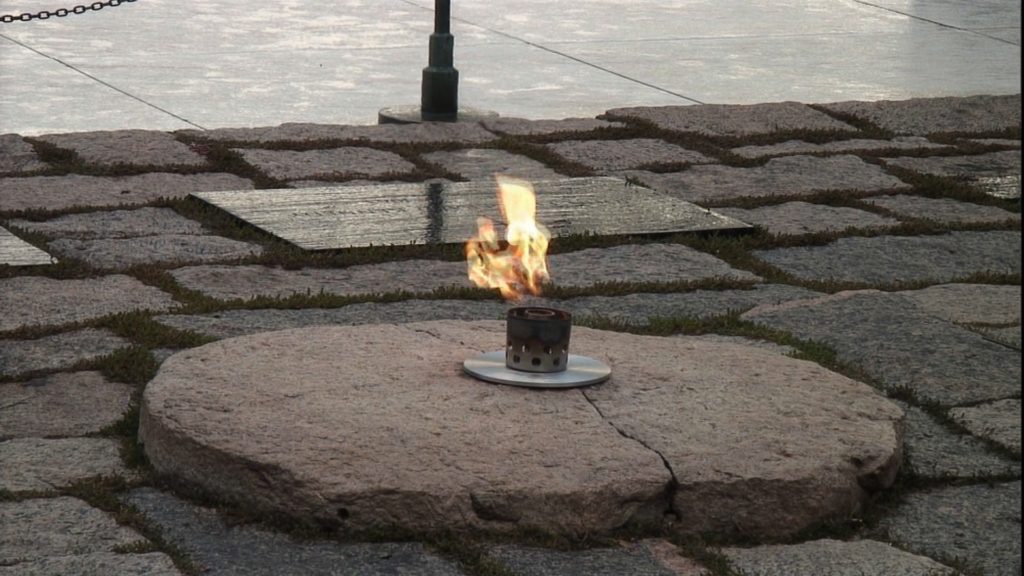
I’ll leave you with a 5-7-5 haiku for consideration:
The Eternal Flame at JFK’s grave at Arlington National Cemetery
Dunkirk NY – Well, here it is, the end of another week. It’s the 56th anniversary of the assassination of John F. Kennedy. I know people right now think this whole Donald Trump situation is a mess, but the 60s were no political picnic either. From JFK’s murder to the resignation of Nixon and the final withdrawal of troops from Vietnam, the era was pretty politically turbulent. On top of the introduction of the Goldwater factor to the Republican party and the subsequent election of Richard Nixon twice, there was a lot of unrest in the streets. Street demonstrations and urban rioting were the order of the day. What’s going on pales in comparison, most notably the lack of any visible demonstrations of any size at all. The outrage of the 60s found its manifestation in people out on the street. Today it’s all social media, a watered-down version of the same. Polls find people are overwhelmed, exhausted, and indifferent. So I am not paying much attention to the whole thing. There is no way the Senate will convict at any rate, but the game must be played out. I’ll make my voice heard at the ballot box in a year. Other than that, not much to do, really.
The knee progresses fine. I have another PT session today, and have already done my morning workout. We have to get serious about final plans for the holiday visits, as everyone will be here by Tuesday night. The Thanksgiving week will go fast, I think. Before I even know it, November will be gone, and December will be upon me. The next question to face after that is whether or not to escape the winter for a little while, or suck it up and stay in the area. I have some Mom care issues to deal with in the winter, so any snowbirding will have to be worked around those dates. Decisions, decisions. -twl
Dunkirk NY – It’s now two weeks since the surgery, and today marked an important event. I took my first turn behind the wheel of a car since the operation. My wife and I went out to do a little holiday shopping Part 1, and she allowed me to get behind the wheel and test the leg out (not without some misgivings). It felt good to be driving, since driving is one of my favorite activities. I experienced no pain at all in terms of leg pressure to the pedals. Sitting behind the wheel was fine. I suspect the upcoming longer trip on Sunday will tell whether or not my legs get stiff from sitting bent, but I should be OK.
Walking around the grocery store was also OK. The knee still feels stiff and walking is not exactly easy, but there is no real pain to speak of. What seems to be more at issue is the sheer physical exertion. Having sat around the house for the past two weeks, part of the issue is now stamina. If I were working, it would clearly be too much to go back to work and put in a full day. The hardest thing to do actually is stand still, and waiting in the short line was challenging. By the time we got back home, I slapped some ice on the knee to relieve the soreness. I think there is a difference between soreness and pain. The knee feels sore, but not painful. I also ended up crashing for a nap this afternoon, so I think my PT exercises, which I did in the morning, will not be getting a second round. Had I not gone out and walked about I’d probably get them done. I did eye that electric scooter car for a few seconds, but in the end decided that the shopping trip was going to be short enough that it would be better to test out how well the leg was doing.
The weather continues to be typical – grey, overcast, temperatures in the lower 40s with some wind chill. The snow that fell on my first weekend home has hung on for far too long, but is finally showing signs of disappearing. I haven’t yet felt the need to break out the SAD light, but it sits there up on top of my filing cabinet, waiting to be plugged in. I bought a cheap six-pack of daylight LEDs and will be replacing some of the lights in the house with them.
I am also getting hooked a bit on cricket, and am beginning to understand the game a little bit better. My middle son became a fan of the game, and he suggested it’s the perfect antidote to the baseball off-season. And he has a point. It has the same leisurely pace as baseball, but if you think pace of play in baseball is a problem, don’t watch cricket. I took in a test match between Australia and Pakistan last night, starting at 7:00 PM, and by 11:15 the match was still going on. It takes five days to complete a test match, and this is the first test match I have been watching. I took in some of the Super50 Championship matches this past week. Super50 is a different game than test cricket, designed to be much quicker (50 overs per side, highest score wins). I’ll probably be doing a larger post over at Joy of Baseball (which is losing a little joy this offseason) talking about cricket as an antidote to lack of baseball.
Thanksgiving is a week from today, and my two boys will be here for the holidays. Brian will bring his partner and her daughter, so there will be six at the table. That will be nice. Thanksgiving is my second-favorite holiday after New Year’s Day. I like NYD because it’s a holiday that is completely devoid of obligations of any sort. Thanksgiving in my family is bigger than Christmas, so if there is any holiday for which my kids come home, it’s Thanksgiving. My daughter unfortunately can’t come from Seattle this year, as she wants to put in as much time at work as she can to make up for the time she lost to the accident. The menu is pretty much set, we’ve begun the shopping, and my wife’s nesting instinct is on overdrive. I am looking forward to a good holiday. -twl
Dunkirk NY – Today began the physical therapy regimen. I am going to a different PT clinic that I did for my left knee, since my former therapist retired and moved to Florida. This is the next major development in rehab, and it will give me something to do for the next month or so.
My initial workup was pretty positive. After almost two weeks of recovery, my right knee is only about 3″ more in circumference than my left, and my range of motion (ROM) is about 10° less. Doing all the icing I’ve been doing has been a help in terms of bringing the swelling down and keeping it under control. My walking gait is almost normal with little sign of limp. So I am starting off in a pretty good place.
I was started off with 10 minutes on a bicycle, which was much different from the first time. A year ago I didn’t get on a bicycle for maybe a month. After that comes a series of leg lifts, quad tightening, heel slides, and so on. The idea is to regain strength in the quads and the muscles around the knee. What’s difficult about these is that they also work the core muscles as well. Once you get into them they are not bad and easy to do. 15 to 30 reps of these things depending on the particular exercise gets it done. I was also surprised by the lack of anything requiring a resistance band. I bought a set anticipating using them, but I did not use them today.
My brother gave me a few more to do, like wall slides, squats, and lunges. I will have to incorporate some of those into my workout over time at home. I get two sessions at the clinic each week, and then work at home. One other difference is that this therapist wants me to do these exercises 2 to 3 times a day. Last time I only did them once a day. I think I will go with two for now, so once in the AM, ice, once in the PM, ice, and then one final icing at night. That should get me up and running fairly quickly.
I realize PT is a short road to recovery, but I am willing to bet that simply normal activity and time will actually do much of the work even if I didn’t do PT. But I have noticed a weight gain of 3.5 lbs, so I do hope that getting the exercises done will result in some weight loss. I rode the bike 2.5 miles today and got my heart rate up to 85, but that is nowhere near enough to burn some decent calories (I think I burned less than 100). I can probably also go for short walks up and down the block as well. So it’s off and…well, not quite running. But we will get there! -twl
Dunkirk NY – Nothing much to report today on the knee. It’s coming along fine. Tomorrow starts physical therapy, bright and early at 8:30 AM. I’ll probably get an evaluation and begin the exercises. I also contacted my brother, who is himself a physical therapist, and he gave me a list of things to try at home as well. PT is actually a bit boring, but it does offer something to do at any rate. Put on some headphones, and just keep repeating the exercises over and over. Tedious, but necessary.
More exciting is the fact that I went and bought a Pixel 3a phone, upgrading from my current Moto G5+. I’m not a big believer in paying large sums of money for phones. In fact, most of my tech is quite minimal in scope. The 3a went on sale for $300 on Sunday, and I could not resist buying it, but not so much to upgrade my phone experience. By all reviews, the camera is supposed to be excellent, and so I bought it mostly for the camera features.
When I am out on vacation, it’s always a toss-up as to whether I will take pictures with my SLR or my phone. The phone wins more often than I care to admit, because it’s just convenient. My SONY A6000 is a good camera, but of course it’s clunky to carry around, and it’s heavy. It takes far better pictures, however, especially when I have the 50-200mm lens attached. If I am in one location where I know I’ll take a number of pictures, that’s the camera I want to use.
On hikes or just walking around, though, the phone is really hard to beat. I’ve also bought a small pocket camera, but then you’re carrying two devices. What’s the point of that? So in buying the Pixel 3a, I am thinking about it as buying a camera upgrade rather than a phone upgrade. I am simply not as dependent on my phone as working people are, so a $300 phone from which I can make calls and do minimal communication work (email, text, chat) is all I care about and need.
Once it arrives I’ll enjoy getting it up and running. I’ve been trying to get a new VPN router going so as to have a higher level of security on my WiFi, but it has eluded me thus far. I think somehow it can’t get past my cable modem’s gateway or something. Technology puzzles are always nice challenges, but this one has me stumped for the moment. The Pixel should be much easier to handle. There are some nice deals on a lot of stuff out there, and when you’re laid up with little to do, internet shopping becomes a way to pass the time. I bit on the Pixel, but I have to resist the rest. Living on a fixed income requires discipline! -twl
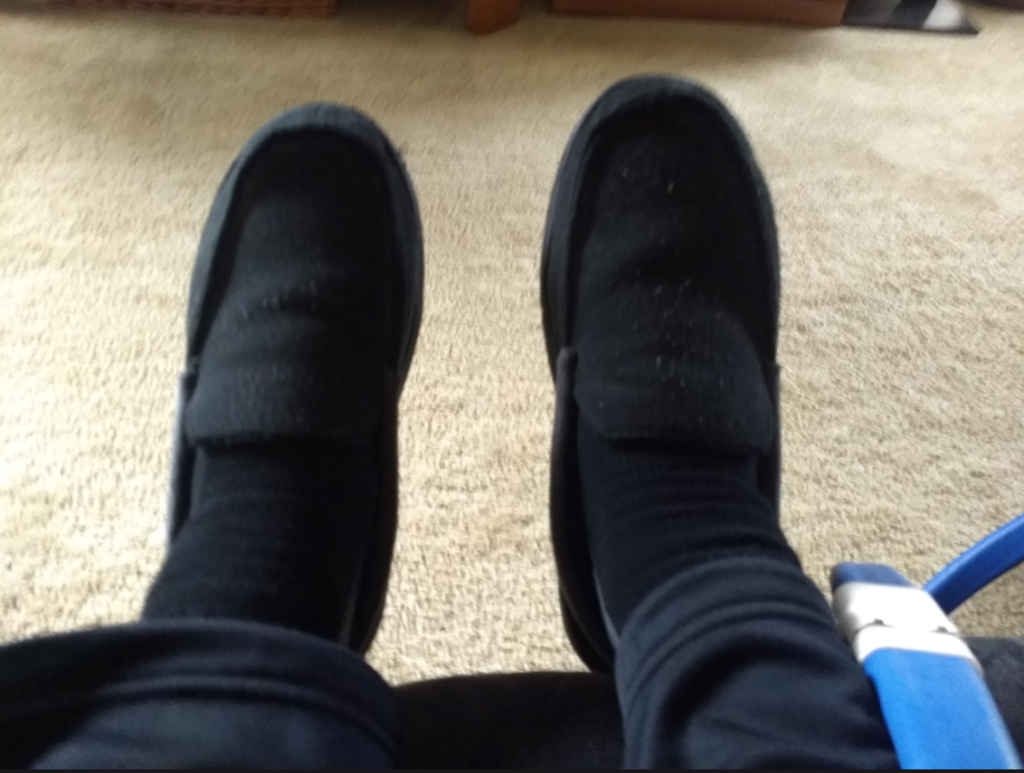
Dunkirk NY – I have a pair of slippers that, come winter, I wear around the house. My extremities get cold very easily due to a youthful bout with frostbite, and so I have to wear something on my feet other than socks. The thing about this particular pair of slippers is that, for some reason, when I walk around the house, I tend to shuffle my feet rather than picking them up. For some reason, in these slippers, that feels a more natural way to walk. I have to make a conscious effort to lift my feet when I walk, but I usually end up forgetting. The result is that I sound like an 80-year-old man shuffling around the house.
Rehabilitation at this point feels like a preview of getting older. Each morning I get up, put on my slippers, socks, sweatpants, a t-shirt, and a sweatshirt. Since I know I am not going anywhere or seeing anyone, I don’t bother to put on regular pants. My day is filled with light activities, such as making coffee, taking out the garbage or recycling, shredding mail, writing, icing the knee. The combination of the shuffling, the appearance, and the activities all feel at this point like the things I’ll probably be doing once I hit 80. When my parents were that age that’s about all they began to do, apart from shopping. My mother, at 90, can do little else, and when I hear myself shuffling it’s almost as if I’m hearing my mother go from her bedroom to the TV to watch Blue Bloods.
It’s not unnerving, but it is, shall we say, revealing. Once this is over I am going to have to remember this feeling so I remain active as long as I can. And perhaps it might be a good idea to get something other than these slippers to wear around the house. -twl
Dunkirk NY – Well, I finally did it. I stretched myself out just a bit too much this morning and my knee got a little tired. So here I sit on the couch once again, icing the knee and giving it some rest for the rest of the day.
Needing a change of pace, I’ve been puttering around the house trying to do small chores around the house. I’ve been down the basement and up on second floor a number of times, requiring the climbing of all those stairs. I’ve been sitting on office chairs rather than having my leg elevated. This morning I moved the couch a bit to see about re-installing some springs (which was not possible), and did a little work in the back room trying to straighten that out. All small items, and I think nothing too strenuous, but perhaps the cumulative effect was more than I anticipated.
It sort of reminded me of the summer of 2000, when I was laid up a bit with some complications resulting in the removal of my gall bladder. I remember feeling pretty good one afternoon and thought I’d go out and take a walk. I got down the driveway and halfway down my own sidewalk before I realized if I didn’t turn back I wasn’t going to make it home. When I got back on the sofa I was completely exhausted. I learned then that when recovering from surgery, you shouldn’t underestimate how long it will take to fully recover. Your body may feel good, but if you try to push it a little before it’s time, you’ll pay.
So since it’s Sunday, I’ll sit here and watch a little football (just a little, to pass the time mostly) and go back to passing the time icing and resting. I can’t afford to screw this up and not be able to drive a week from now for rehearsal. -twl



 More exciting is the fact that I went and bought a Pixel 3a phone, upgrading from my current Moto G5+. I’m not a big believer in paying large sums of money for phones. In fact, most of my tech is quite minimal in scope. The 3a went on sale for $300 on Sunday, and I could not resist buying it, but not so much to upgrade my phone experience. By all reviews, the camera is supposed to be excellent, and so I bought it mostly for the camera features.