

If traveling is currently restricted, then the next best thing is to read some travel literature. I am currently reading the least-known (at least to me) of the Trinity of American Road Literature, Blue Highways, written by William Least Heat-Moon. Published in 1982, the book is an account of his travels across the United States in the late 1970s after losing a teaching job and becoming divorced from his wife. It ranks with the other two famous “road” books: Jack Kerouac’s On The Road, and John Steinbeck’s Travels with Charley. I had heard of the other two, but never Blue Highways. My loss.
The book is part journal, part journalism. Heat-Moon basically does a circumnavigation of the outer edges of the US, starting in Columbia MO, heading to the southeast coast, across the south, up the desert southwest to the Pacific Northwest, across the high plains, through New England, and down back the east coast and across again to Columbia. Right now I am in North Dakota with him, about 2/3 of the way through the book.
It’s a great read. I do feel a certain connection to the man and the travels. He has done something that I’ve always wanted to do, and may yet do someday. Wanderlust is a powerful emotion, and while I have done my fair share of travels in my life, I’ve never quite gone on an extended road trip like this, especially one that follows the back roads of the US. It’s an alluring dream, but the circumstances of my life so far have not offered to me (or I have not chosen to take) the time, freedom, or the solitude to attempt such a journey.
What makes the book so interesting is the writing style. Heat-Moon has the ability to be poetic while simultaneously being narrative. He is very good at engaging with the people he meets, and he is meticulous in reporting the encounters. His descriptions of people are unique in that he seems to capture, not just a description of what they look like, but what their external appearance seems to say about their inner life and their personal conditions in life. Not unsurprisingly, he likes bars and cafes, and he finds most of the people he describes in one or the other. An occasional hitchhiker joins him for a spell. He lives in a Ford Econoline van, long before #vanlife was ever a thing.
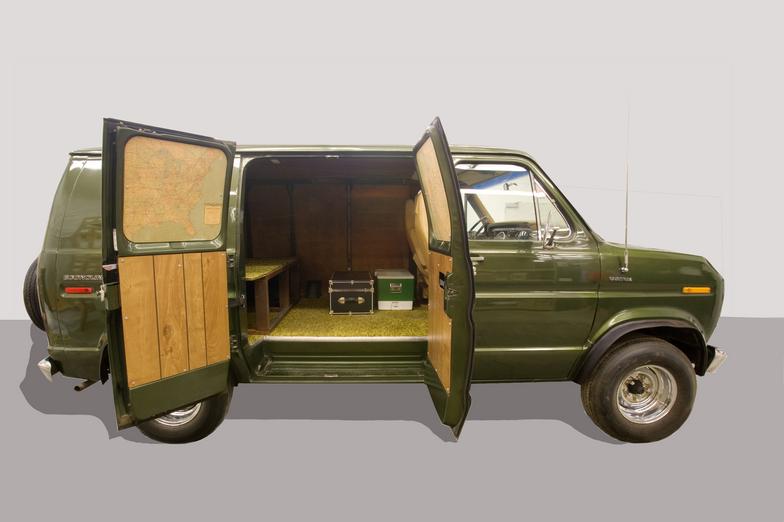
Ghost Dancing, Heat-Moon’s van.
His van, actually, was quite similar to one I owned at that same moment in time, a Ford Econoline E-150 with shaggy carpet interior and no seats. I bought that van in the hope of taking more road journeys after the cross-country trip my wife and I made back in 1976 in a VW Squareback. Heat-Moon eschews the tourist traps, parks, and legitimate campgrounds for simply pulling over on a sidestreet in a small town and sleeping in the van. His lack of gear is astounding when compared to #vanlife today.
In fact, I think I feel pulled to the book largely because of the immense difference I feel between people who are on the road today as opposed to 30 years ago. Today, it’s all about “experiences.” People get on the road to work part-time via the internet and to have “experiences” such as surfing or rock-climbing or a myriad of other experiences one can enjoy. The vans themselves are custom-made, have many of the modern conveniences of today’s technology (Heat-Moon didn’t even have a cell phone), and can cost up to $10-50K. That’s not to mention many of the people who are full-time RVers, with their $50-100K rigs and trucks and assorted toys. It always troubles me somewhat that, in wanting to travel, I come to the realization that the roads today are crowded with these kinds of experience-seekers. I often wonder if it’s even possible anymore to make a journey similar to Heat-Moon’s. Can one really truly get lost in America’s backroads today?
Heat-Moon’s journey was not about seeking “experiences.” It was a journey of self-discovery, of finding one’s self through others one met along the way. It was a journey into the interior of his existence through the external factors of the environment and the people he met. As such, it is a wonderfully satisfying journey to share. There are few pictures in the book, and the ones that are there are mostly quick portraits of the people he met. No landscapes, no scenery, no snaps of building he describes. You are left to feel the land and the people through his descriptions, nothing more. The journey, at all levels, is sparse, intimate, and personal.
I was never taken with On The Road. I tried to read it a number of years ago but found it too chaotic and perhaps a bit self-indulgent. I may have to try again. I’ve never read Travels with Charley and perhaps now is the perfect time to pick up that book and give it a read. Blue Highways is exactly the kind if book I need right now, as I sit sheltered at home, limited in my freedom to travel. -twl

 I decided to follow the Twins for a number of reasons. The first is that they were a playoff team in 2019, losing to the Yankees in the ALDS. They hit the shit out of the ball all season, leading the major leagues in total home runs. They were a very balanced team all year, with decent pitching to go along with a powerful offense. They play in Minneapolis, a city I would love to live in if it weren’t so cold in the winter. Target Field seems to be a very cozy and attractive ballpark. And I have always admired the kind of players and type of teams and managers Minnesota has had throughout its history. Players like Kirby Puckett and Joe Mauer, along with managers like Tom Kelly, Ron Gardenhire and Rocco Baldelli, have made Minnesota, in my mind, one of the classiest organizations in MLB.
 Oakland became the backup because their current team is a scrappy bunch of guys who, as a team, play slightly over their heads. They are always underdogs, and that makes them so much more interesting as a team. They have so many interesting and talented players, from Matt Chapman at 3B to Fernando Rodney (of all people) in their bullpen. Billy Beane continues to do so many interesting things with that team, and they are always in the mix for the post-season. While they have had little success in getting there, they always make other teams nervous. Nobody really ever wants to face the As because they can be so dangerous. And their fans are so interesting! I don’t know of any other fan base in MLB that is so colorful, loud, devoted, and loyal. I have got to get to a game at the Coliseum just to be able to sit near those fans and absorb their complete fan-ness.